

Article Co-Authors:

Commentary on the publication “Artificial intelligence assessment of endoscopic severity and extent: A machine learning approach to continuous evaluation of endoscopic inflammation in ulcerative colitis.” in Inflammatory Bowel Diseases published on July 17, 2026. Research conducted in partnership between Eli Lilly and Iterative Health. Access the article here.
Introduction
The endoscopy subscore is the field’s standard measure of ulcerative colitis (UC) endoscopic disease severity and, along with symptoms, comprises the composite endpoint recommended by the FDA for UC therapeutic trials.[1] It is built on a single principle: identify the worst lesion in the colon and assign it a score from 0 to 3. That principle has enabled decades of consistent clinical trial design and clinical decision making, but it also leaves a widely recognized and well-published gap. Two patients can receive an identical endoscopy subscore while carrying very different burdens of endoscopic activity, since the score reflects one lesion rather than the extent of inflammation across the colon. An AI algorithm was developed and validated to assess endoscopic severity and extent and designed to close that gap by scoring inflammation continuously across the withdrawal phase of colonoscopy. The study tested accuracy and real-world validity using endoscopic videos from a Phase III trial on Mirikizumab (sold as OmvohⓇ) and routine clinical care with the objective to determine if an AI assessment could be a promising alternative offering comprehensive, objective methods to classifying disease severity and treatment response for UC.
The Opportunity
UC characteristically produces inflammation beginning in the rectum and extending proximally through the colon, but its distribution is frequently observed to be patchy rather than uniform, a pattern documented even in patients who have responded to treatment.[2] The conventional endoscopy subscore’s two limitations are well established in the literature. The first is substantial inter- and intrareader variability, which is precisely why central reading exists, as a time-intensive check on what is otherwise a subjective assessment.[3] The second, less widely appreciated limitation is an inherent insensitivity to the extent and distribution of inflammation across the colon.[4] Patients assigned the same subscore can present with markedly different disease profiles and symptom burdens, with potentially different treatment response and relapse risk.
This creates a meaningful opportunity for artificial intelligence (AI) to add a more objective, standardized layer of assessment, one capable of capturing extent in addition to severity, at a scale and consistency that human reading alone cannot guarantee.
AI-Driven Approach and Development
Iterative Health in-house AI/ML team developed and trained a proprietary AI/ML algorithm to assess endoscopic severity and extent (AI-ESe) to measure inflammation continuously across the colon. AI-ESe was designed to evaluate inflammation across the full withdrawal phase of colonoscopy rather than isolating a single interval. The system processes video through a multistep pipeline:
- Preprocessing classifies each frame as usable or not (removing underwater, blurry, poorly prepped, or otherwise uninterpretable footage).
- Stalling detection uses computer vision techniques to track endoscope movement and identify when the scope is stationary, most often during biopsies or focused examination of a region of interest, so that stationary mucosa is not counted repeatedly.
- Interval sampling divides the withdrawal into approximately 15-second segments, treating extended stalling periods as single intervals to ensure representative, non-redundant coverage of the mucosa.
- Severity scoring applies an ensemble of validated deep learning models to independently score each interval from 0 to 3, producing a continuous inflammatory heatmap across the full withdrawal.

Figure 1: Algorithm workflow for artificial intelligence assessment of endoscopic severity and extent (AI-ESe)
Training and development drew on a substantial base of endoscopic video, ranging from several hundred to more than 13,000 videos across component models, sourced from both clinical trials and routine care, to ensure the system generalizes across settings rather than being narrowly tuned to a single dataset.
Study Methods
Validation drew on endoscopic videos from the Eli Lilly’s Mirikizumab (sold as OmvohⓇ) Phase 2 (NCT02589665) and Phase 3 induction (NCT03518086) clinical trials, together with routine clinical care video, with independent holdout sets reserved for performance evaluation throughout.[5,6] Three evaluations anchored the study and stalling detection was benchmarked against uniform temporal sampling and independent human annotation across the videos. Disease severity assessment was evaluated at the interval level, scored by a panel of seven trained readers to construct a 2+1 median reference standard, the current regulatory benchmark for endoscopy subscore assessment. Construct validity and heterogeneity were then assessed on centrally read trial videos spanning all four conventional severity classes, comparing AI-ESe’s aggregate mucosal distribution against conventional subscore classification.
Study Results
Key Findings: The AI-enabled assessments aligned with conventional endoscopy subscores, while also revealing substantial variation in disease presentation within each score. AI-ESe offers a validated, more complete alternative to the traditional worst-lesion score and could improve how disease severity and treatment response are classified.
- Stalling detection reduced mean absolute temporal disagreement from 39.2 seconds under uniform sampling to 23.1 seconds, approaching the 15.5-second variability observed between human annotators.
- Disease severity assessment achieved a quadratic weighted kappa of 0.80 against the 2+1 reference standard, comparable to the range of agreement among individual human readers themselves (0.56 to 0.91).
- When AI-ESe’s output was compared against conventional severity classifications, it tracked the expected monotonic relationship overall, with severely active mucosa rising from 0.0% at subscore 0 to 35.2% at subscore 3 (See Figure 2).
- It was also revealed that patients sharing the same subscore, particularly in the moderate-to-severe range, could differ enormously in the actual proportion of colon involved. Among patients with an endoscopy subscore of 3, moderately to severely inflamed mucosa ranged from 17.9% to 100%. Overlap in inflammatory burden between endoscopy subscores 1 and 2 was especially pronounced, indicating these categories are not fully distinct in terms of disease extent.
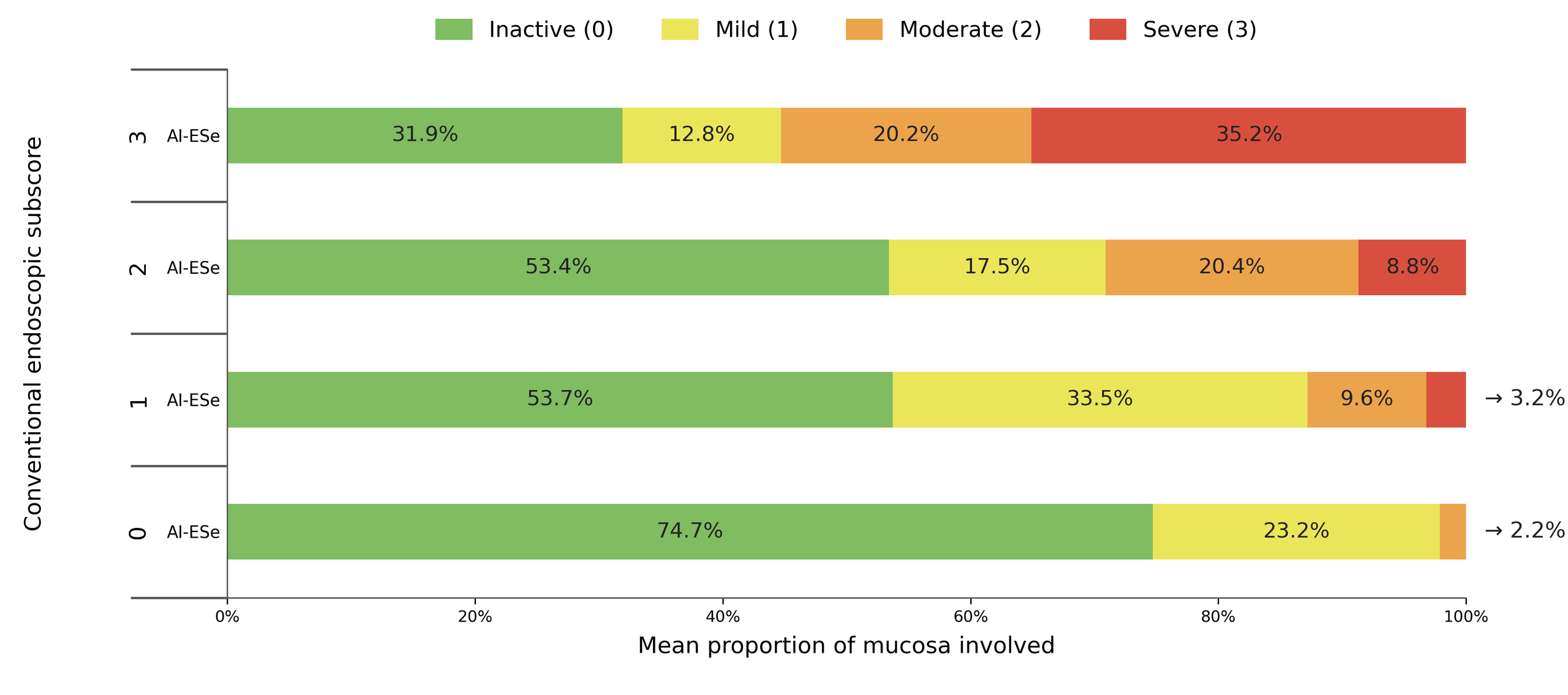
Figure 2: Mean distribution of endoscopy subscore severity via artificial intelligence assessment of endoscopic severity and extent (AI-ESe) stratified by conventional classifications (endoscopy subscore 0-3) based on a 2 + 1 centrally read reference standard.
Perspectives on Clinical and Scientific Impact
From Klaus Gottlieb, MD, PhD
Former Vice President Global Development, Immunology
Eli Lilly
“From a drug development standpoint, these findings speak directly to endpoint interpretation. Endoscopic severity is used as a proxy for whether a therapy resolves the inflammatory process driving UC. If patients grouped under a given subscore vary this widely in true disease burden, that unmeasured heterogeneity becomes noise layered onto the treatment signal, with consequences for statistical power and for how comparable a “subscore 3” population really is across studies. A validated, more granular measure gives sponsors a tool to better characterize trial populations and, potentially, to detect treatment effects that a single-lesion score may currently obscure.”
From David T. Rubin, MD
Professor of Medicine at University of Chicago
Section Chief, Gastroenterology, Hepatology and Nutrition
“This research addresses something many of us have long suspected but lacked a standardized way to quantify. Treat-to-target strategies depend on knowing a patient’s real inflammatory burden, and a score anchored to the worst lesion can understate extensive, patchy disease or fail to distinguish patients who need escalated therapy from those who do not. A tool that reliably captures extent, not just severity, has the potential to inform more individualized treatment decisions at the point of care, provided it is validated further against outcomes over time.”
Considerations on Path Ahead
for AI-Based Approaches
This study establishes construct validity and technical performance. It does not yet establish how extent corresponds to longitudinal outcomes, biomarkers, or symptoms.
Several directions are viewed as promising future use cases of this AI-enabled approach which pose significant opportunities to advance disease understanding, clinical practice, and drug development for ulcerative colitis.
- Patient Population Understanding: Granular characterization of disease severity across patient populations, understanding not just where a patient falls on a four-point scale but how much of the colon is truly involved, and whether that extent predicts relapse risk or treatment response independent of the conventional score.
- Trial Recruitment & Design: Using extent-based measures to inform eligibility criteria, identify candidates well suited to a given mechanism of action, and apply these tools retrospectively to existing trial datasets through post hoc analysis, potentially clarifying treatment effects diluted by subscore-level heterogeneity and shedding light on differential placebo response patterns that have long complicated UC trial design.
- Clinical Decision Making: Continuous, granular assessment may support a clearer understanding of how new and existing therapies affect the true burden of inflammation, informing more precise treatment decisions at the point of care.
Closing Statement
Thank you to Klaus Gottlieb, MD, PhD, and David Rubin, MD, for their contributions to the research project, scientific publication, and follow-on commentary. Iterative Health was proud to partner with Eli Lilly and the University of Chicago for this research initiative and scientific publication.
Explore more scientific publications and research initiatives:
https://iterative.health/latest-news/blog/category/publications/
References
- U.S. Food and Drug Administration. Ulcerative Colitis: Developing Drugs for Treatment. April 2022.
- Bernstein CN, Shanahan F, Anton PA, et al. Patchiness of mucosal inflammation in treated ulcerative colitis: a prospective study. Gastrointest Endosc. 1995;42:232-237.
- Hashash JG, Ng FYC, Farraye FA, et al. Inter- and intraobserver variability on endoscopic scoring systems in Crohn’s disease and ulcerative colitis: a systematic review and meta-analysis. Inflamm Bowel Dis. 2024;30:2217-2226.
- Narula N, Merat S, Liu D, et al. Time to endorse a sensitive method for scoring endoscopic activity of ulcerative colitis in clinical research. J Crohns Colitis. 2023;17:302-304.
- Sandborn WJ, Ferrante M, Bhandari BR, et al. Efficacy and safety of mirikizumab in a randomized phase 2 study of patients with ulcerative colitis. Gastroenterology. 2020;158:537-549.
- D’Haens G, Dubinsky M, Kobayashi T, et al. Mirikizumab as induction and maintenance therapy for ulcerative colitis. N Engl J Med. 2023;388:2444-2455.
- Stidham RW, Cai L, Cheng S, et al. Using computer vision to improve endoscopic disease quantification in therapeutic clinical trials of ulcerative colitis. Gastroenterology. 2024;166:155-167.
- Gutierrez-Becker B, Fraessle S, Yao H, et al. Ulcerative colitis severity classification and localized extent (UC-SCALE): an artificial intelligence scoring system for a spatial assessment of disease severity in ulcerative colitis. J Crohns Colitis. 2025;19:jjae187.
- George AT, Gottlieb K, Colucci DR, et al. Artificial intelligence assessment of endoscopic severity and extent: A machine learning approach to continuous evaluation of endoscopic inflammation in ulcerative colitis. Inflamm Bowel Dis. 2026.